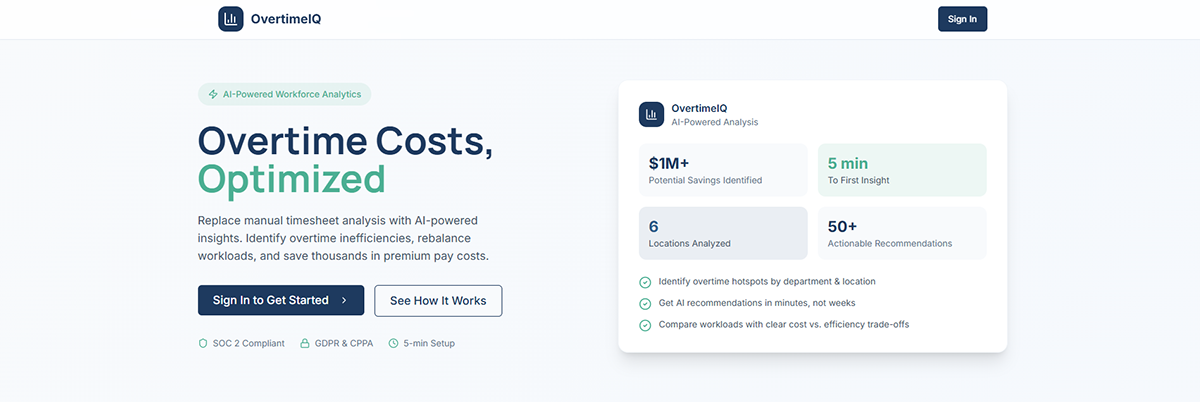

Your Premium Pay Is Telling You Something. Are You Listening?
OvertimeIQ connects directly to your time tracking system and continuously analyzes every dollar of premium pay — overtime, double time, shift differentials, call-in pay, and more. It finds the patterns, flags the problems, and tells you exactly what to do about them.
Most organizations know their overtime number. Very few know why it’s that number, where it’s concentrated, whether it’s getting worse, or what it would cost to fix it. OvertimeIQ answers all of those questions — automatically, continuously, with dollar figures attached to every finding.
What Is OvertimeIQ?
OvertimeIQ is a Premium Pay Analytics Agent that plugs into your existing time tracking or payroll system and gives you a continuous, AI-powered view of all premium pay activity across every location, department, and employee. It doesn’t just show you the numbers — it interprets them, flags issues as they develop, and generates specific, financially modeled recommendations for reducing your premium pay spend.
Unlike static payroll reports that tell you what happened last month, OvertimeIQ operates on live data. It detects trends in real time, alerts you when patterns cross configurable thresholds, and continuously refreshes its recommendations as conditions change.


The Premium Pay Dashboard
The moment OvertimeIQ connects to your time data, it generates a real-time Premium Pay Dashboard that gives you an immediate, complete picture of your premium pay landscape across every dimension of your organization.
Every chart is clickable. Click a department bar to see the employees driving it. Click a pay type slice to filter by that premium category. The dashboard is designed to let you move from the organization-wide picture down to an individual employee’s hours in just a few clicks.
AI-Powered Insights
The Insights engine is where OvertimeIQ’s AI earns its keep. It continuously monitors your premium pay data, detects anomalies and patterns, and organizes findings into a prioritized list with dollar impact attached to every item. Every insight is categorized, tagged by urgency and fix difficulty, and linked directly to the data behind it.

AI Recommendations
OvertimeIQ doesn’t just tell you there’s a problem — it tells you what to do about it. The Recommendations engine analyzes your premium pay patterns and generates specific, actionable recommendations with full financial modeling: current cost, projected savings, implementation cost, payback period, and ROI.
Three Types of Recommendations
1. Float Pool Programs
When premium pay is driven by demand variability — peaks that regularly push employees into overtime — a float pool of flexible workers is often the most cost-effective solution. Float workers earn a modest premium over base pay (typically 10–20%) but cost 20–33% less than overtime hours, and without full benefits, the total labor cost reduction is significant.
For each location where a float pool could help, OvertimeIQ calculates:
- Number of float workers needed
- Current premium pay cost being addressed
- Total float pool labor cost
- Net annual savings and average savings percentage
Payback period from implementation to first dollar of net savings
2. Workload Rebalancing
When premium pay is concentrated on specific individuals who are consistently overworked while peers in the same role have available capacity, OvertimeIQ identifies the rebalancing opportunity and calculates its value. Each recommendation names the specific employees involved, shows their current premium hours versus peer average, quantifies the hours to shift, and gives the projected annual savings.
Recommendations also include a balanced view of implementation considerations:
- Risks of implementing: scheduling coordination, cross-training requirements, ramp-up time
- Risks of not implementing: continued burnout risk, ongoing premium cost, potential turnover of overworked employees
3. Hiring Recommendations
When overtime is structural — driven by genuine understaffing rather than demand spikes or scheduling inefficiency — OvertimeIQ recommends targeted hiring with a full financial model. Each hiring recommendation shows the current OT cost being driven by the understaffing, the estimated implementation cost (salary plus benefits), the projected net savings, payback period, and ROI.
Hiring recommendations include an honest cost-benefit analysis: implementation costs, time to full productivity, and what happens if you don’t hire (continued OT cost, turnover probability, and estimated turnover cost).
4. Scheduling Reviews
When a specific supervisor’s team runs consistently above peer averages, OvertimeIQ flags it as a scheduling practice opportunity. These recommendations identify the supervisor, the team’s variance from average, the projected savings from alignment, and the immediate payback that comes from simply adjusting how shifts are assigned.
Recommendation Prioritization
All recommendations are scored by priority (High, Medium, Low), confidence level (shown as a percentage), and potential savings. High-priority recommendations represent the highest-confidence opportunities with the most significant financial impact. The total savings across all recommendations is visible at a glance, alongside the breakdown by priority tier.

AI Chat — Ask Questions About Your Live Data
OvertimeIQ includes a conversational AI interface that lets anyone in your organization ask natural language questions about your premium pay data — and get answers drawn from your actual live timesheet records, not general knowledge.
Ask it anything about your data:
- Which department has the highest overtime costs?
- Show me the employees in F&B with the most overtime
- Tell me about the Miami property front desk group
- What would the ROI be of hiring additional employees in Housekeeping?
- Why does Housekeeping keep trending upward?
The AI Chat responds with structured summaries, data tables, analysis, and specific recommendations. It surfaces context that might take hours to find in raw reports — instantly. It also suggests follow-up questions to help you dig deeper into patterns worth investigating.
Chat responses are always filtered to your active context: date range, locations, departments, and pay types. Change the filter and the AI’s answers update to reflect the new scope. Every answer is grounded in your live data, not estimates or industry benchmarks.
Use Cases
Multi-Location Employer with Concentrated Premium Pay
A hospitality company with multiple properties discovers that three departments account for over 80% of total premium pay cost. Without OvertimeIQ, that concentration is buried in payroll reports. With it, the cost driver insight is surfaced automatically, the top overtime employees in each department are named, and float pool recommendations with payback periods under two months are ready to act on.
Structural Overtime Disguised as Demand Variability
A department has been running overtime for 34 consecutive weeks. Management assumes it’s seasonal. OvertimeIQ’s trending analysis shows the pattern started long before the season and hasn’t correlated with volume spikes. The recommendation: two targeted hires with a payback period under 24 months, rather than continuing to pay 1.5x indefinitely.
Overloaded Individuals in Understaffed Teams
A housekeeper is running 70% above peer average premium hours while a colleague in the same role at the same property is 46% below peer average. Neither manager noticed because both employees are showing up and doing their jobs. OvertimeIQ identifies the imbalance, calculates the hours to shift, and projects the savings from rebalancing — with an immediate payback period.
Pre-Budget Planning
Finance is preparing the annual labor budget and needs to understand whether this year’s premium pay run rate is sustainable. OvertimeIQ’s year-over-year comparison shows which locations are trending up versus last year, the AI Chat answers what-if questions about staffing scenarios, and the recommendations give a clear picture of how much of the premium pay spend is addressable.
New Location or Acquisition Integration
A new property is added to the organization. OvertimeIQ immediately begins analyzing its premium pay patterns against the rest of the portfolio, surfaces any departments running above network norms, and generates location-specific recommendations — giving leadership a rapid read on labor efficiency at the new site.
Who OvertimeIQ Is Built For
HR Operations and Workforce Management
Finally have the data to answer “why is our overtime so high?” with specifics, not guesses. Identify scheduling practices, team structures, and individual workload imbalances that are driving premium pay costs — and get actionable recommendations to address them.
Finance and CFOs
Understand your premium pay spend the same way you understand any other controllable cost center: with trend data, variance analysis, concentration metrics, and a clear view of what it would take to reduce it. OvertimeIQ gives you the numbers to make the business case for staffing investments and scheduling changes.
Operations and Property Managers
Know when your departments are trending in the wrong direction before the pay period closes. Get supervisor-level breakdowns that show which teams are running above average and why. Act on recommendations that are specific to your location, your departments, and your employees.
HR Consultants and Workforce Analytics Teams
Deliver premium pay analysis across multiple client organizations with a single tool. Generate client-specific insights and recommendations that go beyond what any standard payroll report provides — and back every recommendation with financial modeling your clients can take to their leadership.

What OvertimeIQ Gives You That Nothing Else Does
- Live data, not last month’s report: OvertimeIQ connects to your time tracking system and updates continuously. Issues are flagged as they develop, not after the payroll period closes.
- Dollar impact on every finding: Every insight and recommendation shows the financial impact. You know exactly what each problem is costing and exactly what each fix is worth.
- All premium pay types, not just overtime: Double time, shift differentials, call-in pay, and every other premium rate are tracked together, giving you the complete picture of premium labor cost.
- Trend detection before patterns become permanent: OvertimeIQ catches departments that are trending upward over consecutive weeks — before what looks like a short-term spike becomes a structural cost.
- Actionable recommendations with ROI: Not just “your overtime is high” but “here are the 91 specific things you can do, ranked by priority, with savings projections and payback periods.
- Individual-level visibility: See exactly which employees are overloaded and which have capacity. Workload rebalancing recommendations are specific to named individuals, not just department-level averages.
- Supervisor-level accountability: Manager analysis surfaces which supervisors’ scheduling practices are driving disproportionate premium pay, with the data to have a specific, productive conversation.
- AI Chat for instant answers: Ask any question about your premium pay data and get an answer from your live data in seconds — with suggested follow-ups to help you go deeper.
Frequently Asked Questions

Book a Demo
See OvertimeIQ analyze your actual premium pay data and surface what’s been hiding in your time system. Book a demo to get a live walkthrough with your data.
Overtime Dashboard